Reversibility gates authorization, not confidence


Most agent-authorization schemes I've seen ask the wrong question. They gate on confidence: is the model sure enough to act? Set a threshold, and if the score clears it, the agent does the thing. It feels rigorous. It's backwards. The axis that should decide whether an agent acts on its own isn't how confident it is — it's whether the action can be undone.
I landed on this building the memory layer for my agents, and it's quietly become the most reusable governance rule I have. Let me make the case, because once you see it you'll want to rip the confidence threshold out of your own system too.
Why confidence is the wrong gate
Confidence is the model's self-report, and self-reports are miscalibrated. You already know this — you've watched a model state something false in the same fluent, certain tone it uses for the truth. So when you gate authorization on a confidence score, the actions you wave through most readily are the ones the model is most sure about, and a confident-but-wrong action is the single most dangerous thing in the building. You've built a gate that opens widest exactly when you can least afford it.
There's a deeper problem. Confidence tells you the probability the action is right. It tells you nothing about the cost if it's wrong. And those are completely different questions. "Probably correct" is cold comfort when the failure mode is "permanently deletes the source of truth."
The rule: gate on reversibility
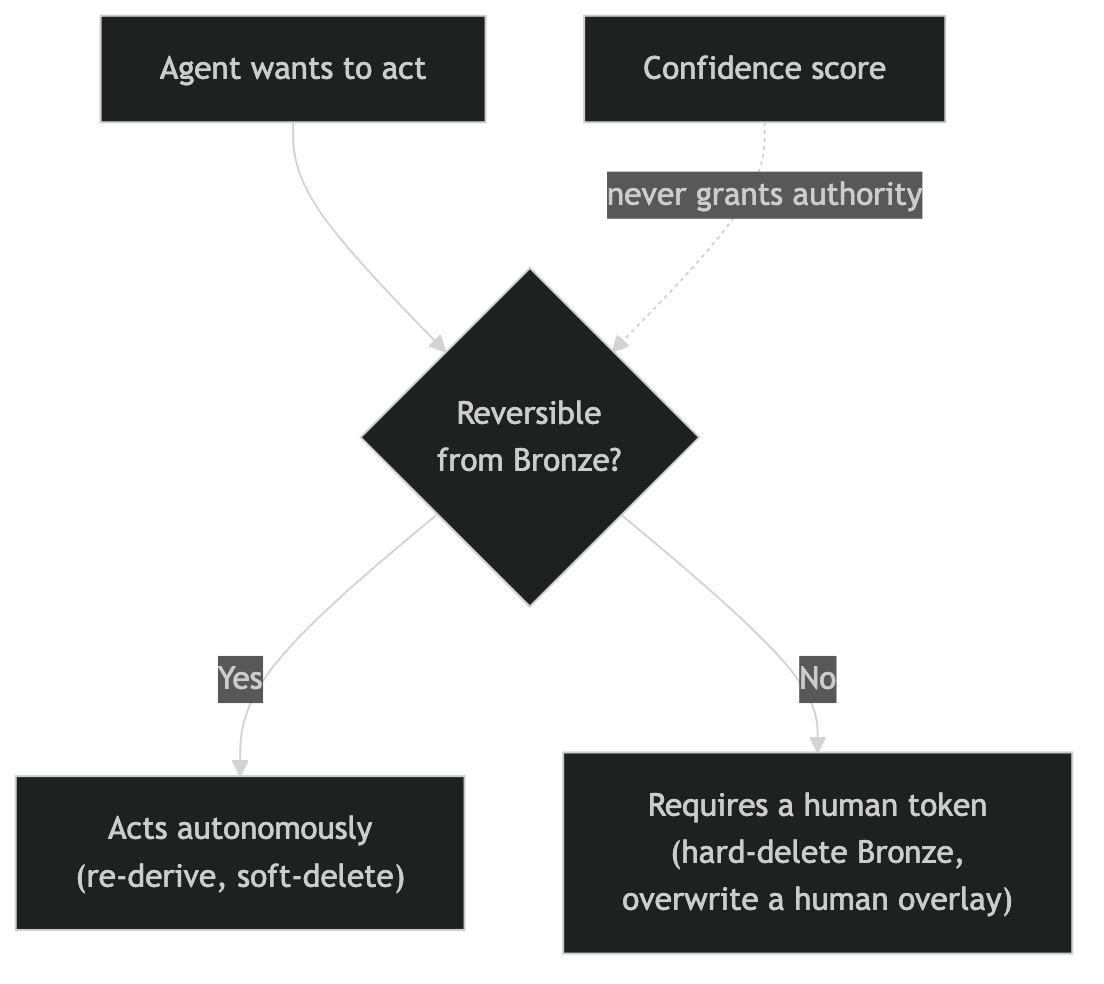
Here's the principle I run instead. An agent may act autonomously only when the action is reversible. Anything irreversible requires a human token — regardless of confidence score.
In my memory system, that line is drawn at the raw layer. Everything lands first in an immutable, append-only store I call Bronze — verbatim, never modified after insert. Every refined fact downstream is derived from Bronze and is, by design, rebuildable from it. So I can hand the reconciler — the autonomous agent that maintains memory — a lot of rope, because almost everything it does is reversible:
- Re-derive a refined fact with a better model? Reversible — Bronze is still there, rebuild it again. The agent does this on its own.
- Decide two facts contradict and supersede one? It's a soft delete — the old row gets an end-timestamp, never a hard delete. Reversible. Autonomous.
- Score a memory's importance? Pure derivation. Reversible. Autonomous.
And the short list of things it may never do without a human holding the token:
- Hard-delete a Bronze record. That's the one truly irreversible act in the system — you can't rebuild from a source you destroyed.
- Mutate a human's overlay — the edits a person made by hand. Those win over the machine, always, and overwriting them can't be cleanly undone.
Notice what's missing from that gate: the confidence score. The reconciler could be 99% certain a Bronze row is junk. It still can't delete it. Certainty was never the question — reversibility was.
Why this works
Here's the part I like: once you say it out loud, the logic is simple. Reversible actions are cheap to be wrong about, because being wrong costs you a rollback. Irreversible actions are expensive to be wrong about, because being wrong costs you the thing itself. So you put the human exactly where the cost of a mistake is unrecoverable, and you let the machine run everywhere the cost is just "do it again." You're allocating the scarcest resource you have — human attention — to the only place it actually has to be.
It also sidesteps the calibration problem entirely. I don't have to trust the model's estimate of its own correctness, which I shouldn't anyway. I only have to classify the action: can this be undone, yes or no? That's a property of the operation, not of the model's mood. It's far easier to get right, and it doesn't drift when you swap models.
It generalizes past memory
The reason I keep coming back to this rule is that it isn't really about memory. It's a governance primitive. The same shape shows up everywhere I let an agent touch something that matters.
In my infrastructure code, the stateful resources carry a prevent_destroy flag — automation can change almost anything, but it cannot delete the database volume without a human deliberately removing the guard. Same rule, different domain: reversible changes are automated, the one irreversible action needs a person. Once you start looking, the question "is this reversible?" turns out to be the right authorization boundary for nearly every autonomous system, not just the one that remembers things.
The catch
One honest caveat, because this rule has a load-bearing assumption: "reversible" has to actually be true. My whole gate rests on the invariant that the raw layer is immutable and everything else is rebuildable from it. The day that invariant quietly breaks — a "cleanup" job that prunes Bronze, a derivation that can't actually be re-run — every "reversible" action I waved through becomes irreversible after the fact, and the gate was a comfortable lie the whole time. So if you adopt this, the immutability of your ground truth isn't a nice-to-have. It's the thing the entire authorization model is standing on. Guard it accordingly.
Stop asking your agents how sure they are. Start asking what happens if they're wrong. If you've drawn this line somewhere different in your own system, I'd genuinely like to hear where — this is one I'm still sharpening. As always, I'm here to help.