The Blueprint Era: why repeatability is the real revolution in AI


Every major technological shift begins with a distraction. Early motorists were captivated by engines, not the quiet discipline of the assembly line. Early computer users marveled at silicon, not the operating systems that made it usable. And today, in the early days of AI, we are all fixated on the models themselves — the power, the novelty, the spectacle. It feels like magic.
But the real transformation, just as before, is happening somewhere quieter. It is happening in the processes we build around the intelligence. The breakthrough is not the model. It is the repeatability.
I did not get there from a keynote. I got there by building one of these loops myself, watching it fail in ways I had not predicted, and slowly realizing that nearly every failure was a process failure wearing a model failure's clothes.
Are you still in the artisanal phase?
Right now, most of us interact with AI the way craftsmen once built cars: one at a time, by hand, improvising through each task. A prompt here, a tweak there, a little more trial and error. It works, but only in the way a single artisan produces a single beautiful object. It does not scale, it does not compound, and it certainly does not create reliability.
If you have ever fixed a bad output by adding another paragraph to a prompt that was already too long, you know exactly what I mean. I did that for months. The prompt grew, the failures got weirder, and every fix made the next problem harder to see.
The shift out of that phase is not a slow, decade-long evolution — it is happening right now, and every month brings new capabilities and new pressure to turn experimentation into something operational. The organizations that succeed will be the ones that treat process definition as the foundation of their AI strategy, not as documentation and not as an afterthought.
What changes when the workflow becomes the context
When you define a workflow, you are not just telling the AI what to do. You are building the rails it runs on.
This is where workflow graphs matter — not as diagrams, but as living systems. A workflow graph is a sequence of steps, each with a clear purpose, its own inputs and outputs, and its own guardrails. Instead of pouring every instruction and every scrap of context into a single prompt and hoping the model sorts it out, each step receives exactly what it needs. The workflow itself becomes the memory. The workflow becomes the context. The workflow becomes the intelligence that surrounds the intelligence.
Mine is a plan-implement-review loop built on LangGraph, pointed at issues in my own Forgejo instance.[1] Each node gets a prompt assembled from the issue, not from a monologue I maintain by hand. That one change — generating the prompt from the workflow definition instead of curating it — did more for reliability than any model upgrade I made in the same period.
Why does a graph make failure easier to find?
Here is the part you feel immediately.
When something goes wrong in a single-prompt system, the failure is buried inside a thousand tokens of conversation and you get to go spelunking. In a graph, it is isolated to a step. A node can recognize that it is confused, classify the type of failure, retry with adjusted parameters, escalate to a different model, or hand the task back to a human with a clear explanation of what happened.
I will give you a real one, because the abstract version sounds tidier than it is. My poller had a re-arm path for a failed step that was effectively unbounded — a failure would re-arm, run, fail, and re-arm again. The loop looked busy and productive from the outside. What it was actually doing was burning tokens like tires doing donuts — plenty of smoke, plenty of noise, and the car never left the parking lot. The fix was not a better prompt or a smarter model; it was bounding the retry at the step that owned it. That bug was only findable *because* the step had an owner. In a single-prompt system it would have read as "the model is being flaky today," and I would have gone looking in entirely the wrong place.
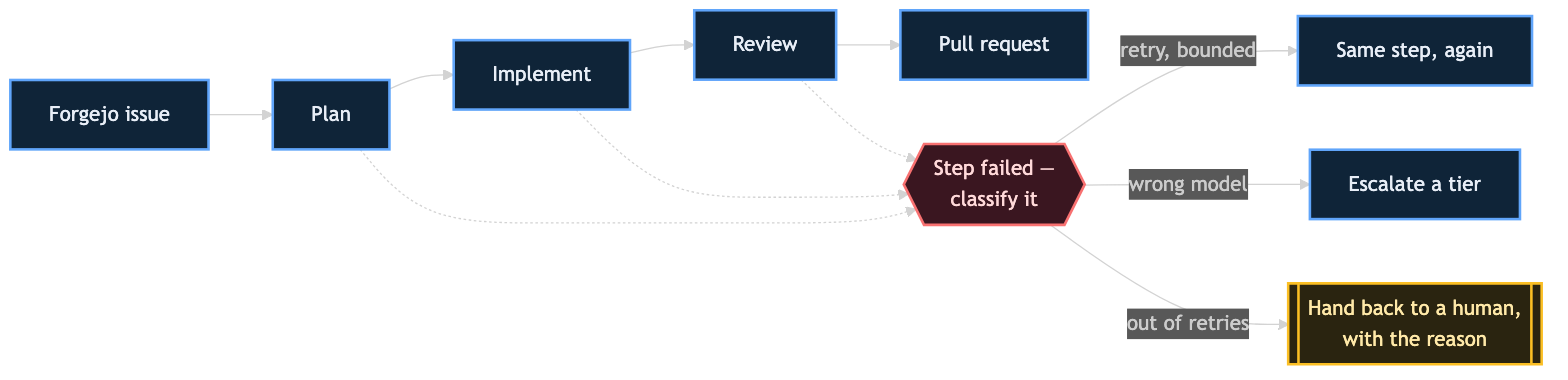
This is how real automation behaves. This is how factories behave. And this is how AI becomes something you can actually trust with work you care about.
Which model should each step use?
One of the most liberating outcomes of this approach is that choosing a model stops being a guessing game.
In the artisanal phase, picking a model feels like picking a wine. Everyone has an opinion, nobody agrees, and half the time you are just hoping. Personally, I would rather choose a good whisky — at least there I know what I like.
In a workflow-driven system the choice gets boring, which is the highest compliment I can pay it. The process dictates the worker:
| Step type | What it needs | What I route it to |
|---|---|---|
| Plan | Reasoning over a messy issue | The most capable tier I'm willing to pay for |
| Implement | Long context, code fluency | A large-context coding model |
| Review | Skepticism, schema-shaped output | A model that holds structure under pressure |
| Classify / route | Speed, low cost, one decision | The cheapest thing that gets it right |
Anthropic makes the same distinction in their write-up on building effective agents — a workflow is a system where steps are orchestrated through predefined paths, and an agent is one that directs its own process.[2] Most of what people call an agent works better as a workflow, and the reason is exactly this: predefined paths are the thing you can debug. I keep the routing itself outside the agent entirely, in a separate service that owns what models exist and which one a given request should land on — so changing my mind about a model is a routing change, not a code change in eleven places.
The part that still surprises me
You do not have to design these workflows from scratch.
The process of defining the process is also something the models are good at. They will draft the initial graph, propose improvements, spot the step you forgot, find the circular dependency you talked yourself into, suggest error-handling strategies, generate test cases, and refine the whole thing over time. I have had a model catch a missing failure path in a graph I had already stared at for an hour.
I have written before about why routing beats picking a favorite model, and about gating the steps that cannot be undone. Both are the same idea as this post, arrived at from different directions: the structure around the model is where the leverage is.
That is the blueprint phase — the moment when the foundation is poured, the scaffolding goes up, and the shape of the thing becomes visible. We are not replacing engineers, analysts, or domain experts; their judgment is what makes any of this worth automating. What we are replacing is the wasted time spent reinventing the same steps and solving the same problems from scratch, one bespoke task at a time. The people stay. The inefficiency goes.
Once your workflows are defined, you stop doing the repetitive work — the system does it. Your role shifts from execution to orchestration, from performing tasks to improving the machinery that performs them. That is the same shift that powered the industrial revolution and the computing revolution: from craft to engineering, from improvisation to repeatability, from isolated effort to systems that scale.
Where to start this week
If you want one concrete move, make it this: take the prompt you have been growing for months and ask what its three steps actually are. Not five, not twenty. Three. Give each one its own inputs, its own success condition, and its own failure behavior. In my own graph, two of the first three steps I wrote had no answer to "what should happen when this goes wrong" — and both of them turned into bugs later. That is where I would look first.
The key takeaway is this: AI is not new, automation is not new, but the combination — intelligence flowing through well-designed processes — is what makes the difference between a demo and something you can run on a Tuesday. The assembly lines of the future are not made of steel and conveyor belts. They are made of workflows, graphs, and the quiet confidence that comes from knowing the system will do the right thing because you designed it to.
And just like the great transformations before it, the real magic is not in the parts. It is in the process.
If you go decompose a prompt after reading this and find something ugly in step two, I'd genuinely like to hear about it — that's the most useful thing that can come out of a post like this. I'm here to help!